
Ice-Out River Walleyes
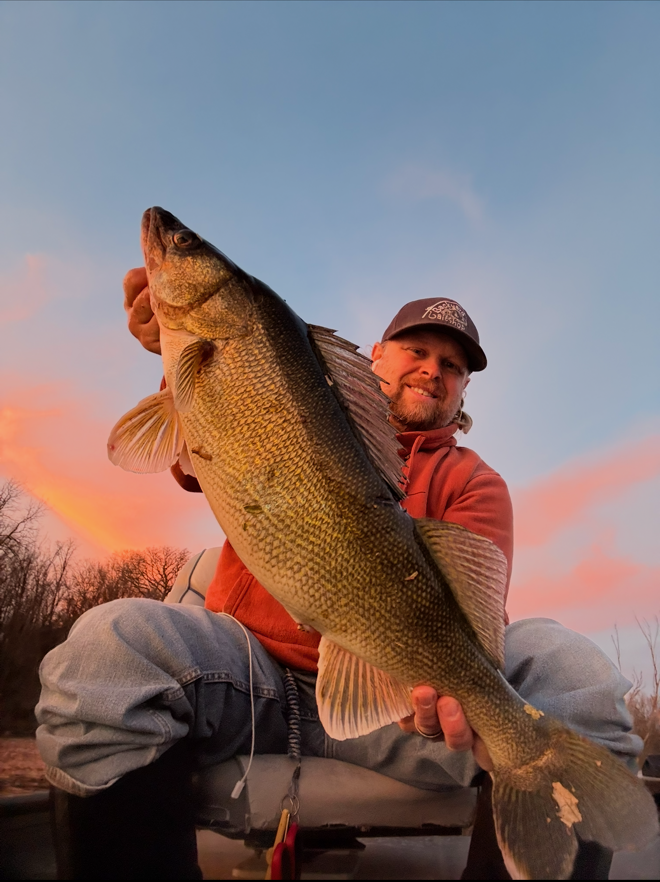
Ice-Out River Walleyes
After the extremely mild winter we’ve had here in Iowa this year, I think it would be safe to say many of us ice fishermen feel like we were robbed of some time. Here in NW Iowa, it wasn’t horrible, but at the time of this writing, I’m pretty confident that southern Iowa doesn’t have much ice at all, if any, on the bigger bodies of water. Don’t get me wrong, I love a nice warm 50-degree day mid-January, but it just doesn’t feel right.
Take Advantage of Mild Winters
This winter reminds me of a time many years ago when I thought I was going to do something really special and go catch some late February walleye at the (now removed) Cornbelt dam. Little did I know that day was going to be more memorable than I could ever imagine. We had a real heatwave the week before, and I remember going down to a local park in Fort Dodge to do some disc golfing. While we walked along the stream, I noticed some crawdads that looked half dead lying on the bottom of the creek bed. This was odd as we usually didn’t see them until late March, but apparently, the water warmed up enough for them to think it was time to crawl out of the mud.
So, I had a brilliant idea. Collect about a dozen of them and go up to the dam, where there have got to be a few walleyes lying around. Surely, they won’t pass up a crawdad freelined in the current seam, right? So, I grabbed a rod, a minnow bucket, and my cheap neoprene waders. Even being new to wading, I was able to walk to the middle as it was really low that year. I rigged up a crawdad, casted, and waited. Nothing. Next, I put a jig on, thinking maybe they want it scooting along the bottom.
After trying this for a while, finally my line went tight, I set the hook, and the fight is on! This is it! This is the one! It’s heavy, and I mean really heavy. This fish is relentless. Wait, something doesn’t feel right. This fish is too strong. I knew what it was, but I didn’t want it to be. Yep, it was a carp. About a 20 lb. carp that had sucked that crawdad right in its mouth. Well, needless to say, I was a little frustrated and started moving closer to the dam, and I was also trying to walk faster than I should have been for the lack of experience that I had.
As soon as I felt that huge stone touch my knees, it was over before I had time to react. Head over heels right into the freezing cold water, rod and all. I could have never imagined how hard it would be to stand upright in waders after falling over, but let me tell you, it took some work.
I will say that I’m glad that I chose neoprene tight-fitting material because if they had been rubber waders, I’d probably still be rolling down the river looking like a balloon when they filled up with water. Needless to say, after that, my “walleye fishing” was over for the day. But that wasn’t going to stop me. It was just the beginning of an absolute addiction to chasing those first-of-the-year, ice-out river walleyes. In this article, I will be covering Walleye tactics for shallow interior rivers.
Prioritize Location
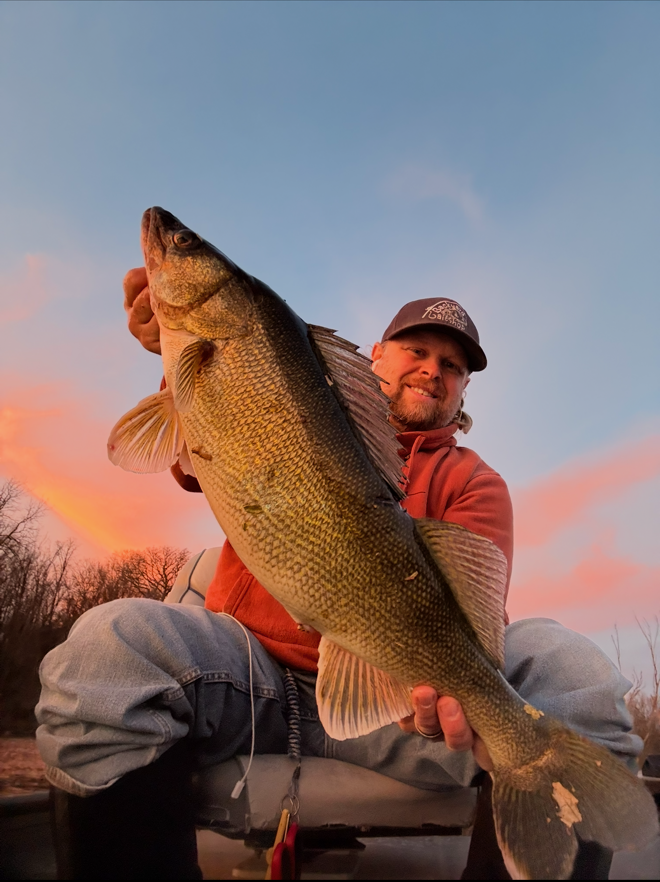
Location is key when looking to bag a few early river walleyes. As the water warms, the fish are migrating to their spawning grounds. They will tend to congregate in the deeper holes as they move upstream and can be fairly predictable at this time. Walleyes will tolerate some mild current, but rarely will you find them in heavy current. They will hold in slack water, eddies, or downstream from a current break. Some examples of these current breaks would be an island, a wing dam, or a large boulder.
Downstream from these breaks is the most common holding place for them, but don’t overlook the upstream side, as there can be pockets of slack water right in front of this structure where a fish can wait to grab food as it drifts by. Feeder creeks are another great place to look for early spring walleye, as there is usually a well-defined current seam as well as some slack water in the creek where baitfish tend to gather. These can be great locations at night where the walleye will move shallow, using their great eyesight to feed on these baitfish.
The most well-known location of all for early river walleyes is the dams. Although they are getting harder to find these days due to removal, the lowhead dams really gather the crowds when the respawn walleye bite is going strong. Not only are the dams a barrier for walleye during their migration, but there are many other reasons for these fish to occupy the area. Oxygen. Oxygen saturation is high in any area where disturbed water can be found. The recirculating current is an excellent source for this.
Walleyes are broadcast spawners and will release large numbers of eggs over shallow rocky areas, relying on wind and current to wash them into rocky crevices for protection, as the adults do not protect the eggs. Food. There is usually an abundance of food at the dams. Live and dead baitfish are constantly being washed around by the recirculating currents and eddies. So, it’s easy to understand why the fish prefer these locations, other than just being stopped by the dam, and where the walleye is, the fishermen won’t be far behind.
One of the best things about dam fishing is the easy access for everyone. Whether you want to fish from shore or wade out into the water, the parking lot is usually close to the water and is accessible at all times (if you can find a spot to park). Sometimes, there are also walking paths along the river near these locations if you want to be an adventurer and get away from the crowds. The walleye is up and down the area this time of year; you just got to go find them sometimes.
When to Go
This is kind of a loaded question. My best answer is any time you can get out of the course! Walleye, like everything else, have to eat all year long, but the ice on the river can prevent you from casting to them. Since the subject is ice-out river walleyes, I’ll narrow it down a bit. I have caught them walking along the ice with a long rod, jig, and white twister in February during a warm year, so I can honestly say as soon as the ice comes off the river, it is game on. The bite will not always be hot and heavy, but I can assure you, they are ready to eat.
The spawn happens when the water temperatures are between 45 and 55 degrees, but can vary slightly. This typically happens in Iowa somewhere between the 1st and 3rd week in April. The fishing is better before and after the spawn, so I usually start in March and fish the river until the last week in April for my area. After that, it’s onto the lake for me, but I’ll talk about that more on another day.
When fishing prespawn walleye, I like to start early in the morning, but it seems like the best bite is when the sun shines over the trees for the first time of the day and warms the water a bit. Then again, in the afternoon, around 3-4pm, especially if it’s been a nice warm spring day. Post spawn is a little more forgiving as the water temperatures gets higher, and the fish get more active. It is fairly easy to get plenty of males during this period, as they will tend to stick around the spawning grounds even after the females retreat back to deeper water to recover from the recent spawn.
To Wade or Not to Wade?
Wading for walleye is a favorite pastime for many anglers in the first days of open water. This sort of approach to fishing can have some significant advantages, especially for seeking out pressured fish. Another key advantage of wading is finding holes and identifying the bottom composition. A walk in the water can tell you a lot about the area you plan to fish. Some observations you’ll want to take note of are how much current is there? How deep is it? How big is the hole? Is the bottom sand or rock? All these factors will help you identify whether this is a fishy area or not.
When wading in the river, it is always a good idea to wade with a friend, especially if there is any ice at all still moving down the river. This can be the difference between life and death at times, so please consider this advice. When the water is cold, it’s hard to beat a good pair of well-insulated neoprene waders. Staying warm could be the difference between a fun-filled day of fishing and a miserable day of shivering. Also, the tight-fitting neoprene will help keep the water from filling up your waders in the event of a fall (refer to the introduction of this article if you need a reminder).
If wading doesn’t appeal to you, walking to the shoreline and making several casts can be just as productive, if not more. When shoreline fishing, you can cover more water and easily rule out unproductive water simply by observation. The river will usually tell you what’s going on below just by looking at the surface. Remember, the current breaks and slower-moving water are going to hold the most fish. Once you find some walleye, be sure to work the area over well, making several casts.
Rods, Reels & Lines
When fishing walleye, it is important to feel the bite as they will sometimes lightly scoop the bait up and other times, they will completely inhale it, giving you that well-known walleye “thump”.
Having the right rod, reel, and line will increase your chances of feeling the bite, whichever way they choose to attack. A carbon or graphite rod is a good choice for any walleye angler because they are a bit stiffer than a fiberglass rod through ¾ of the blank. Power ratings on rods can be understood in terms of stiffness. Power ratings for early walleye fishing range from light to medium-heavy, depending highly upon how much the lure you are using weighs. For my style of fishing, a medium-light power rod is just right. Action is where the rod bends, as in how far down the blank it loads up.
Fast action it loads up near the tip and slow action it bends down the blank further towards the handle. For me, a fast-action rod is perfect. With a fast-action carbon rod, the sensitivity is unparalleled. I won’t go into much detail on length, but the 6-7’ range is ideal. Choose whatever length that you are comfortable with. I prefer 6 ‘3″. Reels. I’d say spinning reels are probably the top pick for walleye fishing these days.
Choose a light weight spinning reel in the 1000-2500 range for size, with a silky spin to it, and a smooth drag. For me, keeping the whole setup as light as possible is a must. I run a size 1000 reel to prevent fatigue from jigging all day. Walleye don’t make big runs, so I’m not too concerned with holding over 150 yards of line on my reel. Line. This subject can cause division at times. You’re either old school or new school. Braid or mono? Mono has stretch, is more forgiving on hard hooksets, and is easier to manage in below freezing temps.
Mono is a single strand, hence the name. If it gets nicked, the integrity of the line is compromised. If you prefer mono, the 6-8lb range would be a good choice. Braid, on the other hand, has no stretch, is not as forgiving on hard hooksets, and is a big problem when the temps are below freezing, although I’m hearing some good things about some newer cold-water braid that performs well in these circumstances. Braid is multiple strands braided together, which is much stronger than mono when damaged. The non-stretch qualities of braid make it much more sensitive, which is my first choice. I’ll save the mono for catfishing and use 8-10lb braid for walleye. Quick review on my setup- 6’3” medium light power fast action rod paired with a 1000 size spinning reel loaded with 8lb white braid.
Jig heads
Lead heads or jig heads are one of the choices of terminal tackle that connect you to the fish when you’ve convinced them to bite. There are many styles and sizes to choose from, and this is where it pays to play. Don’t be afraid to try out different sizes in order to key in on the presentation that they prefer at the time. Sometimes they want it to knock the bottom, and other times a slow fall will trigger an aggressive attack.
Nothing replaces time on the water and a whole lot of trial and error figuring out what they want. My advice when it comes to weight is to start heavy and work your way down. By starting with contact with the bottom, you will be able to adjust until your jig just barely touches bottom every so often, staying in the strike zone longer. Don’t be afraid to go as light as 1/16 oz, as this can sometimes turn around a slow day.
Keep in mind you will have to work a lighter jig slower, though, giving it time to sink while drifting downstream. Finally, when choosing jig heads, always make sure that they have a sharp hook. I’d hate to know how many fish I’ve lost due to a folded-over or dull point. For this reason, I always carry a hook sharpener with me to touch up hooks. Rocks can be very detrimental to hook points, even on premium hooks.
Plastics
White and chartreuse twisters have probably taken more spring river walleye than any other lure on the market, and for good reason. The white always imitates a natural baitfish, and chartreuse stands out like a sore thumb, grabbing the attention of a hungry walleye nearby. If there was another color that ranks with these 2 heavy hitters, I’d say it is probably green pumpkin. But that’s boring. Sometimes you have to “stand out from the flock,” like a good friend of mine says. There are so many varieties of shapes, sizes, and colors of plastics these days that I couldn’t even scratch the surface of what is available. Swimbaits, split tails, and curly tails are the staples for targeting river eyes with plastics.
My best advice is simple. Find a small business (or a few) local to the Midwest that makes something you like, and stick with it. Try different colors and styles until you unlock the code, and then keep it to yourself. These walleyes see the same things over and over every year. If you want to increase your catches in the future, give them something they don’t see every day. You’ll be surprised how easily you can out fish your buddy 3 to 1 when you’ve figured out something that they just can’t resist, and he’s next to you using a white twister.
Live Bait
Matching the hatch is one of the best ways to put a few walleyes on the stringer when the water is cold. Nose hooking a walleye minnow on a jig can sometimes be the best way to get a stubborn walleye to bite. When working a jig and minnow combo, the key is to slow it down. Let the jig sit 5-10 seconds before lifting again, slowly drifting it downstream until a hungry walleye scoops it up. Sometimes it’s best to give it a moment before setting the hook if you are getting several short strikes.
Another way to fish a minnow is to set up a Carolina rig with a walking sinker, 24” leader, and a floating jig head. Don’t use too much weight, but enough to keep it on the bottom. ¼-½ oz should do. Still fish this rig for about 5 minutes at a time, covering the whole area. The floating jig and minnow will flutter around in the current, just teasing the walleye below. When you see the line twitch or feel pressure, let the line tighten up all the way before setting the hook.
Time to Eat
Now that you’ve got a few to take home, it’s time to enjoy your bounty. Catch and release is a great practice, but there’s nothing wrong with having some fresh walleye now and then, especially the first few of the season. Tender, white, flaky, and crispy fried is my go-to for walleye most days. I like a nice thin crispy cornmeal breading on mine, and I haven’t changed it up much in 30+ years. For the breading, I use a 50/50 mix of Zatarain’s crispy southern and Andy’s original. Dip the filets in milk just to wet them and roll them around until coated. Fry in peanut oil until crispy and enjoy!
March 2026
by Geoff Taylor
For Leading Dairy and Cattle Industry News: