
Whitetail 365: Tracking Goes to the Dogs
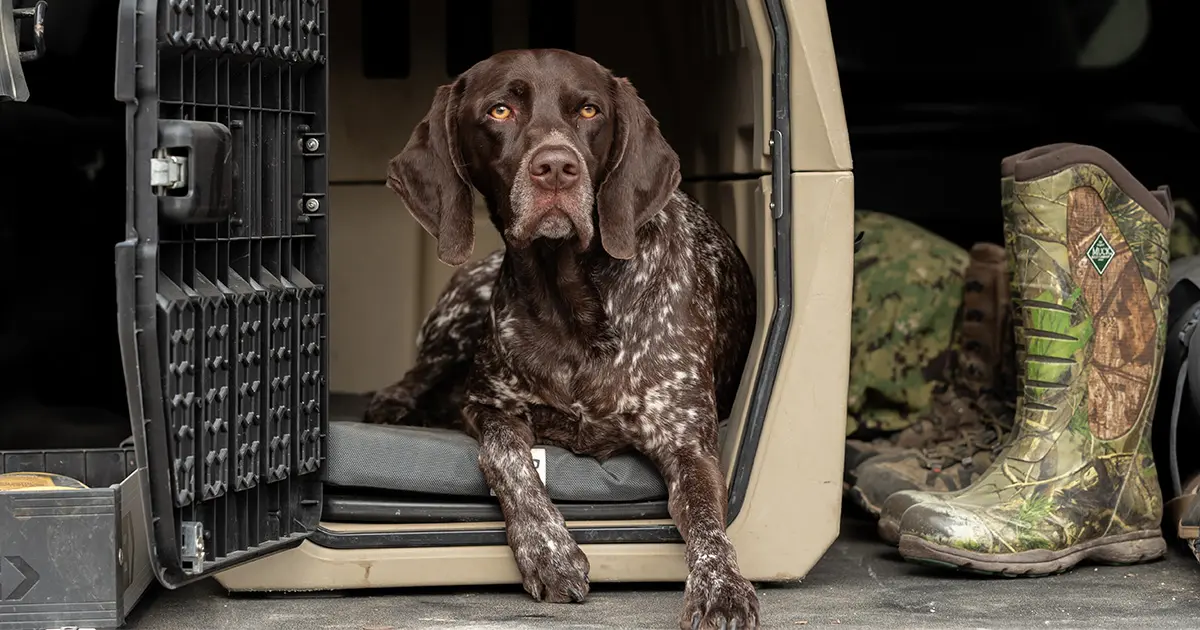
Whitetail 365: Tracking Goes to the Dogs
By Noel Gandy
Way back in 2018, I submitted my very first article for this great publication. The title was “Whitetail Shot Placement Outcome and Blood Tracking Guide”. As you can guess, this was a piece written for a season kickoff issue to help a hopeful hunter AFTER the shot. So much ink is spilled in regard to preparation and execution. However, I quickly realized this was the very last time that I wrote in regard to life after the shot. Since the fall of 2018, we have experienced Brexit, the COVID-19 pandemic, and multiple US presidents. Even more, I personally have trailed or assisted in trailing over 20 deer since then, so my experience has grown.
Learning Through Experiences
If anything, from these experiences I have learned that not all trailing is equal. Sometimes, it’s cut and dried. The deer is hit, leaves significant amounts of blood and other signs, and is recovered quickly. Other times things can be a bit more tedious. The worst case is you wound an animal, the trail runs cold, and you are left to wonder if he expired or if he lives on another day.
Iowa Rules and Regulations
Along with all of the other changes that have occurred since 2018 is one that significantly impacts an Iowa deer hunter. In 2020, Governor Kim Reynolds signed the bipartisan legislation to allow the use of leashed dogs for blood tracking to recover wounded deer. The current law for tracking a wounded deer with a dog, as stated in the Iowa Hunting, Trapping and Migratory Game Bird Regulations for 2026-2027, states on pages 36-37:
“A dog may not be used to hunt deer. However, a person having a valid hunting license and a valid deer hunting license who has wounded a deer while hunting may use a dog to track and retrieve the wounded deer. The person must maintain physical control of the dog at all times during the search by DEER 37 DEER means of a maximum 50-foot lead attached to the dog’s collar or harness. The person may dispatch the deer using a legal method of take authorized by the person’s deer hunting license. A person shall not use that method of take to hunt, wound, or kill any animal other than the deer that the hunter is tracking, except in self-defense. Using a dog to track a wounded deer on private property is permissible at any hour with consent of the property owner. A person using a dog to track a wounded deer outside of legal deer hunting hours shall not be in possession of a long gun, bow, or crossbow. An unarmed dog handler assisting in the recovery of a wounded deer is exempt from licensing requirements as long as the handler is accompanied by the licensed hunter who wounded the deer.”
This is an incredible advantage to a hunter to be able to exhaust all natural resources to ethically harvest AND recover an animal.
Utilizing Dogs for Recovery
While I hoped that I would never have to utilize the services of a tracking dog, I was incredibly grateful to Colby Baker with Booner Whitetail Recoveries in 2023 when he made himself and his dog, Boone, available to me after a shot that hit the back of the lung and the liver of my largest whitetail ever.
Tough guys will say to make a better shot, but the margin of error on a living and moving creature is incredibly small. Couple that with immense nerves and adrenaline, and even the most seasoned archer can wish he’d done better. By all accounts, I thought the shot was perfect. However, upon video review, we realized that the buck was quartering to just a touch more than I had realized, and the steep angle of a seven-yard shot from a tree stand was enough to cause the gut to seal the exit. Therefore, there was no blood trail leading into incredibly thick habitat. After grid searching for two days (a no-no according to Colby), I called Boone into service, and he found the buck over 400 yards away within about 20 minutes. It was absolutely incredible.
I’d encourage anyone to search the archives for that original article I wrote back in 2018 if you are ready to take on the trail solo. However, if you find yourself in need of a tracking dog, then I’m happy to share that after interviewing Colby for over an hour recently, I have some information you might like to know!
Advice From a Tracker
Colby is a Southwest Iowa resident and a long-time whitetail enthusiast. When the legislation allowed the use of dogs for tracking deer, he began researching breeds and landed on a Catahoula from deep down in Louisiana. This dog was bred with a tracking pedigree, and his breed and breeder were recommended to Colby by other respected trackers. He picked up his pup, Boone, the namesake of Booner Whitetail Recoveries, and began work. The team will be entering their fifth year of trailing wounded deer in Iowa, NW Missouri, and SE Nebraska, where they have made over 100 recoveries!
Tracking Scent
What I found most fascinating from my conversation with a seasoned tracker is that, for Boone and many other trained tracking dogs, there is very little emphasis on blood. This was a myth that was busted for me. The dog works by tracking the scent that is distributed from the interdigital gland that is located between the toes of the animal.
Apparently, the fight-or-flight scent pheromone is what the dog is sensing and therefore seeking out. According to Colby, deer have their own personal scent they put out through the interdigital gland. The wounded pheromone becomes stronger when shock occurs and becomes more distinct as death’s door begins to close. This allows the dog to differentiate a particular deer on the trail where multiple deer could have possibly used it.
One great issue for a tracking dog comes when human intrusion occurs and moves scent around. We do this by putting footprints on top of the scent and then disturbing the natural trail, leaving micro trails. While this does not make it impossible for Boone, it does make it tougher.
When to Call a Tracker?
I asked Colby, “When do I need to resolve to call a tracking dog to assist in the recovery of an animal?”
His response was that different trackers would vary on when to call in a dog. However, he is a whitetail purist at heart and said, “Part of hunting is taking up the track. That’s part of the fun. I hope everybody makes a shot and has the chance to trail and find the deer for themselves or with friends because that is part of the whole experience. However, my suggestion is if you get to the point that you feel the need to start a grid search, that’s when it’s best to give me a call. I can gather a little information from you like shot location, distance, and such, and either give you some advice on how to proceed or I can head that way with Boone.”
Best Practices for Hunters
He reiterated, “If you are on the blood trail, be sure that you’re walking off to the edge of the trail and not right on top of it. That way, the scent that Boone will be trailing won’t be disturbed so badly. I know it’s tough not to hover over blood, especially if you’re looking for specks, but that is a best practice.”
I went on to ask a flurry of questions because the topic was so intriguing. Allow me to give you a myriad of “facts” that came from the conversation:
Fact: Moisture like rain, fog, and the heaviness of the air traps the scent down on the ground. If it is not a downpour and more like a couple of tenths of rain, then that is awesome for tracking!
Example: an inch of downpour in 15 minutes might be bad but still not impossible.
Fact: The 68-70 hour mark was the longest he’s ever waited to trail to still find deer. The conditions were excellent then, but that should give the reader plenty of hope. In fact, it was stated that he likes to wait until the 24-36 hour mark on a gut shot deer before even starting the track. This gives the deer a better chance to expire.
If you’re looking to call, he suggested doing so within the first 24 hours. The 48-hour mark is a little long to wait, but still not unattainable.
Fact: According to his experience, shoulder-hit deer with a bow have statistically lower odds of recovering. Deer that are gut shot are more likely to be found than deer that are shoulder shot.
Fact: At least in Boone’s case, the dog can let you know if the deer is likely to still be living. The experiences of the tracker have shown that when the dog loses interest, then the pheromone that secretes the wounded scent tends to have dried up, indicating an animal that will survive.
Exhaust Every Effort for Recovery
Tracking wounded deer with dogs, while relatively new in our state, is a wonderful tool for a hunter to have in their arsenal for post-shot recovery. One of the main criticisms that this writer has heard regarding the use of dogs is that it potentially incites taking riskier shots because of the added benefit of trailing with dogs. Let’s do this: let’s resolve that we are going to hunt and shoot ethically and use tools as tools, not crutches.
There are pages and pages of information that couldn’t fit into one article when it comes to trailing whitetails with a dog. However, I hope that this gets you started on the right track. If you are in need of the service of a tracking dog, then I suggest checking out my friend Colby Baker and his dog Boone. If he’s not in your area, then places like www.unitedbloodtrackers.org are a wonderful resource and a jumping-off spot to get the assistance you need.
Follow us on Facebook! The Iowa Sportsman | Facebook