
Mid-Season Crappies
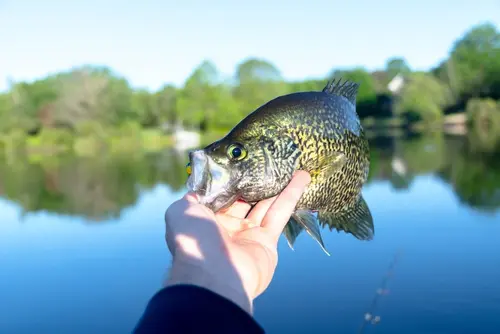
Mid-Season Crappies
Basin Basics
It’s a pattern perhaps, as old as the species itself. It’s as predictable as a bad sit-com and as dependable as Old Faithful. Once the early ice period ends, crappies will begin to migrate and suspend over basin areas. For the ice angler, it is actually good news. Once you can find the depth of basin they’re suspending over, you should be able to catch crappies all day long….as long as you stay mobile. Granted it might not be the lights out fishing that can occur at sunrise and sunset, but sometimes, during the dead of winter, it’s a comfort to know that you will be able to consistently land crappies during the time between those two magical low light periods.
Because crappies can become quite scattered as they move to these areas, “basin crappies” is a term that, historically, strikes fear in the hearts of many ice anglers. In the summertime, finding crappies scattered across the basin isn’t a big deal because in the span of an afternoon we can make multiple trolling passes across the basin and eliminate all the water that doesn’t hold suspended crappies. Fortunately, we have technology now and the modern methods that we can closely duplicate this activity even through the frozen surface of a winter-time lake. Utilizing these methods, we can now catch late season crappies almost as effectively as we can during the softwater months. All of these factors combined make finding these fish such a sure thing that “basin crappies” has become one of my favorite things to hear after the lakes freeze up.
Basin Areas Defined
Before you begin chasing crappies suspended over the basin of a lake, it might be a good idea to know exactly what the “basin” is. The basin is typically the largest mass of water within the main body of the lake. It is usually defined by a continual sloping of the bottom to a centralized area which is often the deepest spot on any given body of water. Some lakes, like North Dakota’s Devils Lake, might even have multiple basin areas distributed amongst multiple bays and sub-lakes. In pothole glacial lakes, it is typically the area with a “dishpan” shaped topography. The basin may even make up the whole lake for some smaller bodies of water.
For man-made bodies of water, it can often be more confusing. Submerged roadbeds and flooded ridgelines can often break a reservoir’s area into multiple basins. While it is feasible to think of such situations as one large basin with features on the bottom, I often find it less overwhelming to divide it into separate basins based on those features and develop my strategy from there.
Ice Trolling
Regardless of the size or shape of basin that I’m trying to cover in my search for suspended crappies, ice trolling is an absolutely essential part of my strategy. I have previously covered ice trolling in other articles, so I won’t belabor it here, but I will at least layout the basic theory and execution of the technique. As its name suggests, ice trolling involves trying to duplicate the way we fish from our boats as closely as possible, even though we have a frozen sheet of ice impeding our progress. It involves drilling lots of holes and quickly checking each hole with a flasher or camera. Since basin areas can be huge, we are trying to cover as much ice as possible, which means we often don’t even stop to fish a hole unless our electronics shows us a suspended mark. This is a hard thing to do for perch fisherman who pursue schools of perch roaming mid lake flats with a similar technique. The main difference being that perch anglers will usually fish every hole for at least a minute or two to look for any marks rising from the bottom.
Go Deep!
Unlike perch, crappies are typically not found on the bottom, so there is no need to entice them to rise from the bottom where our electronics can make a positive identification. This being the case, unless there is a suspended fish in the hole, keep moving and checking until your electronics show you one.
Since the goal is to cover as much water as quickly as possible, holes are typically drilled widely spaced from one another. Sometimes holes are 50, 75 or even 100 yards apart. With holes spaced this far apart, it’s easy to see how much less overwhelming a large basin area starts to become when using this technique. Any hole that ends up giving up a crappie is worthy of having a few more holes drilled in closer proximity to it. Chances are good that there may be a pod of crappies in the area, or some structural element that might concentrate at least a few of these scattered fish.
Once that hole or grouping of holes stops producing, it’s time to get moving again. That being said, don’t hesitate to go back and re-check those holes a little later. Often when I ice troll, I can go back to a once hot hole after 15 minutes, 30 minutes, an hour or even at the end of the day and find another fish or two in the area. The important part to remember is that unless you have a fish below you, you should be moving and imitate as closely as possible the way you would troll from a boat.
Tackle Selection
When chasing basin crappies, I like to go a little larger on tackle than most folks do for panfish. There are a couple of reasons for this. First of all, basin crappies are often found in the deepest water in a lake. And while they are suspended, a crappie suspended 6 feet off the bottom in 45 feet of water is still a long ways down there. Heavier tackle allows me to get down to them more quickly. The crappies you find in the basin are often some of the biggest crappies in that body of water, so going a little bigger sure doesn’t hurt in this instance either.
One of my favorite lures for basin crappies is a 1/8 ounce Northland Forage Minnow Spoon in glow red. If crappies are especially hungry, I can often get them to bite without even tipping the treble hook with anything. If they do take a little more persuasion, I’ll load up each tine on the treble hook with 2 or 3 eurolarvae. Sometimes, I‘ll even horizontally rig a soft plastic Nuggie, made by Little Atom, on one of the points of the treble and have great results. If the crappies are neutral or negative, I’ll replace the treble with a short dropper chain with a single hook and impale 1 eurolarvae on the hook. If the crappies are really aggressive, I may even move up to a ¼ ounce spoon. Other spoons I have used for this application with great success would be the Frostee Jigging spoons from Lindy and Swedish Pimples from The Bay de Noc Lure Company
My favorite days are days when the big crappies are actively patrolling the basin in search of roaming baitfish. These are the days I like to tie on a #2 Jigging Rapala or a #3 Chubby Darter and hook into these big girls. The predominant baitfish in the lakes I fish are shad and fathead minnows, so I really like the silver shiner, shad and chrome patterns in these baits. On the days when the crappies are snapping these baits up, hang on because you’re in for a great day!
Mix It Up!
There are still days when I will have to eventually go to a jig. For the same reasons that I like a heavy jigging spoon, I always go with a tungsten jig in these situations. Tungsten fishes heavier than lead, so it lets me get down the fish quickly and makes detecting bites easier. Unlike bluegill fishing where I try to use a very small tungsten jig, I like to go with a 4, 5mm or bigger for basin crappies. Nine times out of ten, when I’m using a jig for basin crappies, it will have a Nuggie on it.
Using plastics for crappies paired with a gold tungsten jig allows me to quickly go through many different colors until I find what the fish want. By staying with a constant color jig and using the plastics to vary my colors means I don’t have to re-tie every time I need a color change…just thread on a different color plastic and send it back down the hole. I have also had good luck with the Little Atom “Skimpies”, “Duppies” and similarly shaped plastic tails, especially in the 2-tone color combos. For some reason, crappies respond very well to highly contrasting colors, so I use 2-tone plastics every chance I get. Besides 2-tones, my best plastic colors for crappies seem to be white, bubble gum, motor oil, purple, red, or anything that glows.
Rod and Line Selection
My rod and line selections for chasing basin crappies are driven by the baits I’m using. That means I’ll use slightly heavier tackle than I would if I were chasing early ice crappies or bluegill. A light action rod is as light as I will typically go, and that will only be used with the 4 & 5 mm jigs I mentioned earlier. The rest of my rods are usually medium light with a few medium action rods thrown in for Chubby Darters.
I’m a big fan of super lines like Fireline Crystal and Nanofil for these mid-winter crappies. The low stretch allows me to detect deep water bites more easily and makes for much better hookups when crappies suspend in the lower portions of the water column. I do run fluorocarbon line occasionally, especially when the fish seem to be line shy. Regardless of whether I’m using a super line or fluorocarbon, I really like 4 pound test for this application, but also have 3 or 2 pound line on the light action rods with jigs on them.
Big Water Means Big Opportunity
Don’t let the massive amount of water in any lake basin scare you away from chasing crappies in the heart of winter. While the amount of water to explore in any basin can be intimidating, the crappies will be there. Using today’s electronics, highly efficient power augers, and maintaining a mindset of mobility, these fish can be found in even the largest basins. When you do find them, be sure to be properly geared up, because these fish can be deep and they can be big. These two factors alone will make chasing mid-winter crappies worth all the time and effort you put into it.