
Whitetail 365- The August Advantage: Building Your Buck Inventory Before the Rut
Whitetail 365- The August Advantage: Building Your Buck Inventory Before the Rut
Sponsored by:

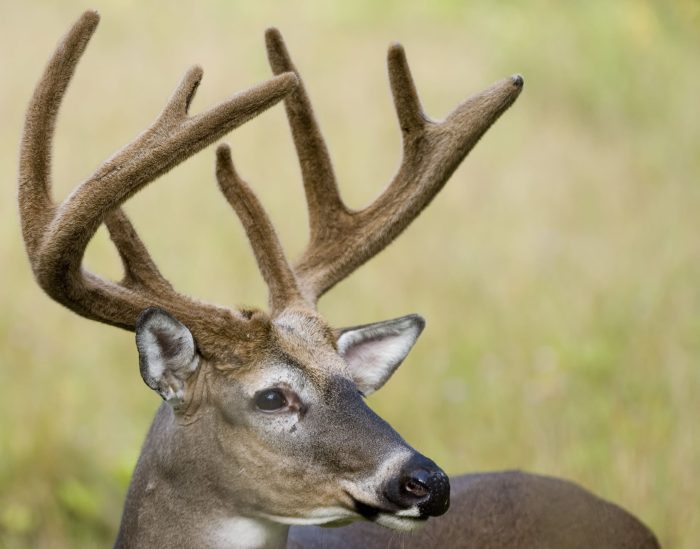
Recently, a guest of my podcast and I were having a brief conversation before recording about bucks in velvet. We discussed the anticipation for hunting season. He and I both agree that you have to be so careful when you analyze summer buck inventory of a farm because there is a good chance that those particular deer might not be on the farm come fall. This led to a conversation about proper expectations, and I’d love to share some thoughts regarding summer inventory expectations versus fall reality.
For the sake of this article, instead of using hypotheticals, I will use a personal experience of mine from 2021. On July 7th of that year, I took off on my annual bean field scouting trip to my happy hunting grounds in SW Iowa. I had already deployed a couple of trail cameras the month before, so I had a good idea of the bucks that I was hoping to find in velvet and hopefully put a game plan together for the fall. To my utter shock, surprise, amazement, and bewilderment, the field began flooding with deer. Buck after buck exited the timber to the tune of 10-12 bucks and that many or more does.
Preseason Work
I had never seen that many deer in that area! Can you imagine the great excitement? As darkness began to fall, out stepped my target buck for the year. A deer we called “Stare Down” entered the field and was the menace that alluded me the entire fall before. To my surprise, though, behind him stepped out an even larger buck! This buck had double main beams on one side and would easily have scored 150” on JULY 7th!
I made it my life goal to take that particular buck. Plans were hatched, strategies were formed, and I had what I thought to be a foolproof setup to get that particular buck killed, no matter where he was on the farm. I set multiple trail cameras and had a really good idea of his movement: that is, until September 22nd.
Analyze Trail Cam Data
Eight short days before the beginning of the archery season, I got a series of trail camera photos. They showed “Doublewide”, as he had been affectionately named, moving off of the property. The buck that had been a homebody for two and a half months. He left the farm and was no longer a resident of any property that I had permission to hunt. In fact, the very next evening, I checked a trail camera on a farm that is nearly two miles away. It had his photo heading North on that particular camera. Just by luck, I had snagged this photo that let me know not only was he not on the farm, but he wasn’t even close!
Had it not been for trail camera technology, there is a very good chance that I would have pursued this deer, who was not there, for a great deal of my hunting season. It is difficult to chase a ghost when the ghost does not exist. I can only imagine the frustration and horror that would have been utilizing precious time off from work and family, brutal cold and fruitless sits, and passing perfectly acceptable bucks only to NOT shoot this big guy.
Narrow Down Their Home Range
The fall home range shift is a very real reality that has to be taken into account when summer scouting is taking place. That fruitful evening in July taught me that not all of the bucks that are on a property during the summer, in their bachelor groups while they are friends, will remain there during the duration of autumn. In fact, I never saw at least three of those bucks again. It also taught me, however, that some of the bucks WILL hang around. Remember “Stare Down?” Come to find out, he was one of those bucks that called the farm home.
Outside of a brief two-week expedition during the rut, I had visual or photographic evidence of him for the entire season and the next, which culminated in his demise during the second gun season of 2022. It took some time, but the stark realization came into place that some bucks are more likely to use certain areas than others, and it is much more fruitful to hunt a deer where he is rather than where you hope he’ll be.
Maximize August Scouting
During your summer scouting trips, it is wise to take into account all of the bucks that you can, with the understanding that some of them will be resident and some will wander away to other home ranges. What I have learned, though, is even though some of those deer might range, there is a good chance that they will wander back through during the rut. Such is the case for the double-wide buck. He left the farm in September, and that was the last time he was seen until I received a singular trail camera video of him during mid-late November. While he was not a resident, my farm was still on his radar, and he made a pass through during his two-week expedition. Were the chances high that I could have killed him? No, but they weren’t zero.
The same thing happened with a giant drop-tined buck I was chasing in Kansas the very next year. He was around all summer until he wasn’t. However, in mid-November, he chased a hot doe through the farm, and I was able to sling an arrow his way. It was total luck that I was there the day he was, but I’d rather be lucky than good any day.
Utilize Cell Cameras
One of the ways that we can really be low impact in monitoring our herd is through the use of trail cameras. In particular, I enjoy monitoring cellular trail cameras. There are loads of options and technology that can give a hunter a real leg up on scouting while keeping you from disturbing your area too much. That’s my main reason for using them: access. Most of the places that I hunt are permission pieces that are largely surrounded with crop fields. There is not much room for hoofing it around the field edges much less using a side by side or an e-bike.
Deploying cellular trail cameras can assure that I can get in the fields or timber early in the year so I don’t disturb a farmer’s crop and I can still do my summer scouting in real time. To me, knowing what a deer was doing last month does not help me much in the here and now so non-cellular cameras in remote areas are not my favorite.
Leverage Technology
Technology is constantly changing and usually for the better, and it is no different for trail cameras. I received my first trail camera when I was in high school as a Christmas present. If I remember correctly, it was somewhere in the neighborhood of $300+ dollars, and you still had to take the film out to be developed. Boy, have we come a long way! Nowadays, you can get a quality cellular camera for $50-$100. The cost of operation seems to be going down as well.
One question that many non-cell cam users might have is in regard to cellular plans. In short, the camera companies have partnered with cellular providers to offer low-cost plans per camera. These plans are usually purchased, maintained, and changed through the particular camera brand’s app, whether online or on your smart device. They have no bearing on your current cellular plan and stand on their own. I can say with great sincerity: it’s very simple!
Analyze The Data
Tracking wise, many mapping companies are teaming up with various trail camera providers to give photo cataloging and mapping abilities. As you check into cameras or mapping tools, they will generally give plenty of info of which are compatible with one another.
I drew a Kansas tag this year, so I am excited to head South and get started with my scouting. I plan to deploy a few trail cameras on some field edges in hopes of starting to make plans and fostering dreams of big bucks. Since I don’t live nearby, I plan to use a solar panel to aid in the battery life of my cellular cameras. I’m using the same brand of solar panel as my camera, but there are many third-party sellers of these panels. These small panels affix to a tree or post in the same way that your camera does. As expected, they work much better where they can capture and harness direct sunlight. Timber is tough on a solar panel. Be sure when you are shopping that the cabling that goes from the panel to your camera has the right connections.
Utilize Options
There are so many options nowadays to get extended battery life out of your cameras. After last year, it became incredibly expensive to run lithium batteries, so many folks and companies got creative. One of the ways that I plan to extend battery life this year is to run an external battery. I purchased 10 cables that have the trail camera connection on one end and the other end attaches to a 12-volt battery. This is an experiment for me this year that I’ll gladly report on in the near future. I hope to get a whole season out of a $22 setup.
Utilizing good tools, like trail cameras, boots on the ground, and common sense, will aid in putting that plan together for a great deer. Don’t forget, however, it can also give you a good bead on a buck that is or is not using your farm. Make sure you do not sell out on a buck that might not be near your area. While it’s incredible to dream of that monster that passed through in the night, you have to ask yourself, could that dream be reality? Either way, I hope all of your wildest deer hunting dreams come true!
For Leading Dairy and Cattle Industry News: