
Artifact Hunting in Iowa
Artifact Hunting in Iowa
I will admit, in high school, one of my least favorite subjects was history class. I’m not sure what rubbed me so wrong in those years, but something has changed since then. As I grew older, I think I realized how much history could help people shape the future. Knowing our past allows us to learn certain things that help make our future better and brighter.
But somewhere in there, I also gained an interested for Iowa’s history. I knew that the early settlers came across Iowa in the early 1800’s. However, there were people here long before that. Native Iowans, or Native Americans, lived off this land long before European Settlers ever ventured through Iowa’s prairies and timber.
These people lived off the land. They hunted for food, gathered and foraged the land, built their own weapons and fishing equipment, built their own homes, and did so much more for thousands of years before we were here. This thought amazed me. I mean, let’s face it, if you and I lost all the comforts that we have now, could we live off the land in the same way? I would be willing to bet that many men and women would struggle.
But here’s where we come in, out there in Iowa’s streams, rivers, lakes, and fields, many of these tools were left behind. We’re not always sure why they were left behind, but they are there, and we can learn a lot about the history of Iowa’s people by hiking around and finding these ancient treasures. But you have to be ready to put the miles on! This is not for those who don’t enjoy a good hike.
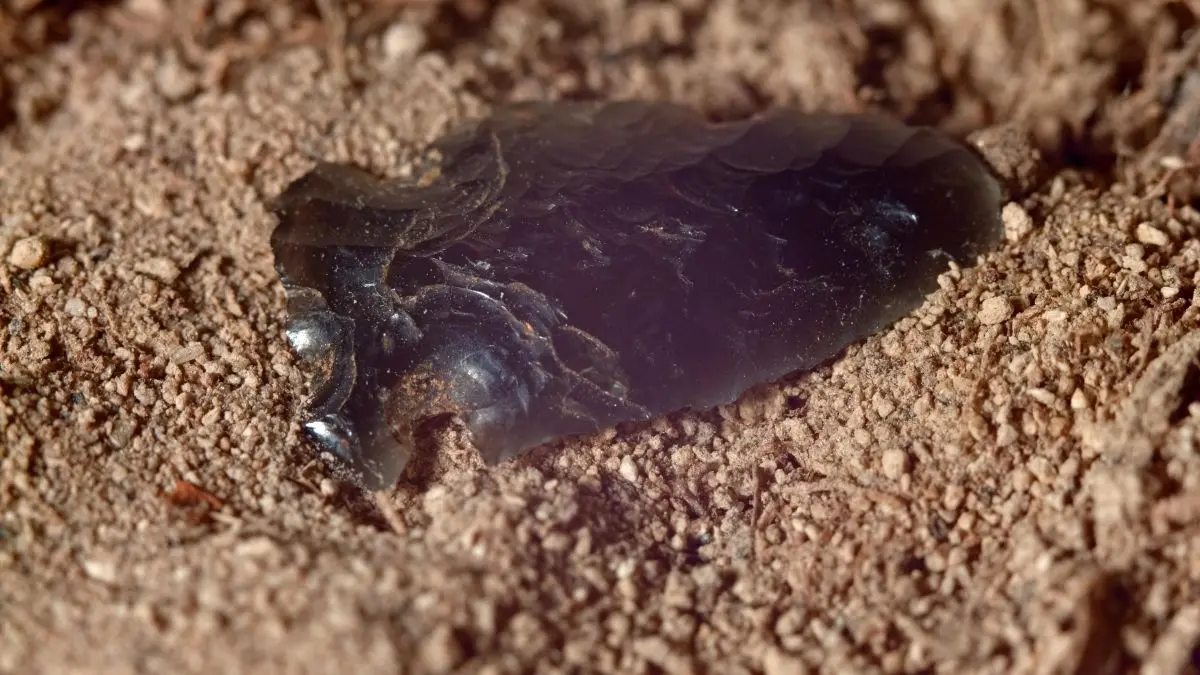
When we are hunting for artifacts, we are mostly looking for stone tools whose shape is anything but natural. These tools will have a “chipped” sharpened edge, very smooth surfaces, or perfectly matched angles or geometric shapes. Things that will catch your eye and your brain, causing them to question, “There’s no way that was shaped naturally.”
Where To Look
There are four main areas to look for artifacts. They are rivers, streams, lakes, and fields. There are some tricks to each, and where to look, as well as when to look.
Let’s start with fields. In my experience, looking in central Iowa, this is where I, as well as my fellow artifact-hunting friends, find most of our artifact treasures. When I approach a field, I zero in on high ground that might be located just to the east side of ravines or other timber sections. You see, many Native Americans would set up their camps in these areas. If there was ever a prairie fire (which happened), it often burned from west to east because of prevailing west winds. But if camps were on the east side of ravines, people were often protected from fire jumping the ravine and continuing. Fields on the east sides of divides or long-standing timbers are good fields to key into.
With fields, the best time of year to search is in the spring and early summer. The timing is key here. You see, we need to work with the farmers as they are preparing the fields for planting. Buried artifacts are often moved up towards the surface of the ground by winter frost. As frosts freeze and thaw, these stone tools are actually heaved towards the surface. Then, when a farmer discs the ground in the spring for planting, if the artifact is near the surface, the disc might just expose it. After a couple of spring rains, these stone tools often lie on the surface or are partially exposed. You’ll have to go look before the crops get too large to find these treasures. Once the plants overgrow the rows, they are more difficult to spot.
Streams and rivers are similar when it comes to places to look. Although rivers tend to be a bit wider, they both have sandbars, washouts, and rocky pileups that happen in the turns. When I’m hunting in rivers or streams, I’m looking for rocky sandbars along the straight of a river and the bends of a river. Take a slow walk that would cross these areas multiple times. If an artifact has been tumbled down a river or stream, it is very likely to “pile up” where other stones and rocks do the same.
I also look for dirt banks that are washing out in a bend of the river. If there are any artifacts that were buried in the dirt of those banks, eventually, they are going to wash out into the river. If you’re lucky, you might even find bones or antlers of ancient animals that no longer exist on Iowa’s prairies. Iowa has been known to deliver bison, elk, and even mammoth bones in some of these wash-outs. Bones are just as exciting as artifacts!
Lakes are yet another area where you can find artifacts, too. In my experience, I haven’t found that many in these areas, to be honest with you. However, I do have some friends who have had some luck over the years on some of Iowa’s “Great Lakes”. Searching the riverbank as the levels rise and fall will often reveal what has been washed out of the bank of the lake, as well as what might have been lost near the edge of the lake. Some of Iowa’s recent droughts have exposed a lot of treasures as the lake levels have fallen. Lakes are something to try. Paddling a canoe or kayak around the edge could reveal some amazing things!
Items to find
When it comes to artifacts, anything from Iowa’s past falls into this label. As I have mentioned previously, bones, stone tools, and pieces of pottery can all be found hidden in Iowa’s layers of ground.
Bones and antlers are great finds. Many of Iowa’s Prairies were covered with elk, deer, and bison. In fact, when Louis and Clark came across the country on their expedition west, they journaled that they saw millions of bison along the vast prairie lands. Overhunting, floods, and prairie fires all took a toll on these animals, and eventually, they were hunted into extinction from Iowa’s species list. But the bones of these animals are still found from time to time. Occasionally, bones from species during the Ice Age are found, too. Animals such as the mammoth, musk ox, and even the older buffalo species called Steppe Bison. Teeth are also found in these areas.
When it comes to stone tools, people’s most common find is usually what we call an “arrowhead”. These are points that range from one inch to three inches long with a distinct symmetry from a base to a point. Many different styles were particular to the time period and the tribe that was making them. Truthfully, many of these artifacts that we call “arrowheads” were used more as knives. Smaller points that we call “bird points” were used on arrows for hunting small game and large game.
Bird points are much smaller and lighter. Probably letting an arrow travel further and faster. Bird points would look like an arrowhead, but would probably measure one inch or less in length. They could be used to hunt just about anything. Native Americans would and could eat just about anything.
One of an artifact hunter’s favorites to find is an axe head. These heads were often “carved” instead of knapped (chipped). Once a stone with the desired shape was found, they were usually rubbed over and over again against another stone using sand as the main grinding element. These were rubbed/carved to a sharpened point as well as carved with a groove on the back half, allowing it to be lashed to a sturdy stick, bone, or antler. Axe heads ranged from small to large and were most often used as tools. Like we would use a modern-day hatchet.
One last fun piece of artifact to find is pottery. I’ve found this in washouts as well as stream and river banks. You’ll just notice a piece of rock that literally looks like a broken pot. Sometimes they have very nice little patterns around the shard of pottery. They are usually a darker brown/red color because of the “firing” that helped make the pot. And, you will see that they are of a sandy consistency of clay. But I’m sure, just like us in these days, pots were useful for many things!
As I wish you well and send you out this spring and summer to find these treasures, I’ll leave you with this thought. When you find an artifact, think about the hands that last touched it before you picked it up! The person who handled this piece of history was a part of Iowa’s real history. There may have been a few hundred years between their hands touching that piece and yours, but it’s still a pretty neat thought to think about. Good luck!
May 2026
By Ryan Graden